Friday, 19 February 2010

What makes a good book?

Originally published on Fingertips on 08/02/10

Amid the advances represented by Apple’s iPad and Amazon’s Kindle I’ve felt like something of a Luddite lately as I’ve made my way through assorted battered paperbacks.
Unlike the Luddites I’ve so far not managed to get my hands on an iPad or Kindle, but then I don’t really feel any inclination to do so either.
This is partly because I’ve got so many unread books lying around – the product of having eyes bigger than my bookshelves and spending too much time browsing in charity shops – but also because I love books not just as literature, but as objects in themselves.
I don’t know what an iPad feels like, but it can’t feel much different to an enlarged iPod which feels cold and soulless. I’d always rather put on a CD album and flick through its sleeve notes than listen to it on my iPod and read about the album online.
But even more than CDs, books have a unique, tangible side to them. Every book is different, be it in size, thickness, hardness, smell, or feel.
As I wrote about the new design of the Granta magazine – a deceptive name as it’s actually produced in book format – on one of my now-abandoned blogs back in 2008:
“When I picked it up, I felt drawn to it. Its matt cover is seductively calm to hold and as your hands brush the gloss cover image something akin to arousal flutters through your fingers.
“This new Granta is engaging more of my senses than the old Granta. It has a new smell, and these thicker pages sound different as I turn them. Maybe I should lick it.”
Just as important as the feel and the smell of a book is its cover.
Covers can define a book, can set the idea of a book firmly in our heads before we’ve read it and be the first trigger points when we remember a certain book.
Penguin’s cover designs
Penguin’s changing approach to cover design is documented in Phil Baines’s book Penguin By Design.

With the arrival of the 60s and Alan Aldridge as art director, the company’s covers became less generic and more about expressing an individual book’s ideas.
This was seen in the cover for Aldous Huxley’s Island and has continued to the present day thanks to designers like David Pelham who developed the idea of giving authors’ books a particular look.
Take for example the Evelyn Waugh covers that he oversaw, which for some readers may define the books as much as the books themselves.
Wayne Gooderham discussed this last year on the Guardian Books Blog:
“Obviously, the text is the thing, but the cover of a book can surely influence our reading of said text. I’m sure there are many readers of Breakfast at Tiffany’s who cannot help but picture Holly Golightly looking uncannily similar to Audrey Hepburn thanks to the cover photograph’s tyrannical hold over our imagination.”
The perfect cover
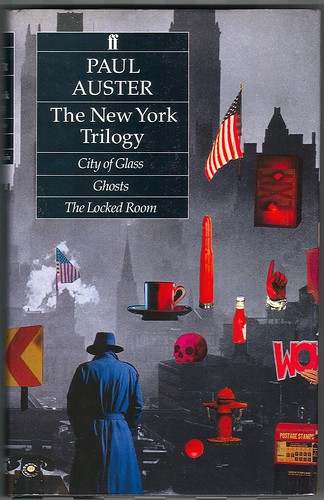
He goes on to discuss the search for the perfect cover, and that for him the first Faber and Faber paperback edition provided just that for Paul Auster’s New York Trilogy.
Yet my copy of New York Trilogy is a later edtion, and this for me is the perfect cover: with its simple blurred shot of a quintessential American image it represents pure Auster – something American, undoubtedly, but seen through the squinted and suspicious eyes of years spent feasting on European literature.
Gooderham’s preferred cover just looks tacky, like GCSE art work. It doesn’t feel beautiful and real yet slightly unsettling in the way that Auster’s writing does.
The point is that books are objects of beauty that hold an individual allure. Your copy of such and such a book is your copy, and every crease in the spine that you’ve fingered for hours while reading it is yours alone. Every faded page or every coffee stain is yours.
Like an animal marking out his territory, you have marked this out as your book, and the cover is a part of that. And the dirty stain that my copy of John Banville’s The Infinities acquired after I put my bag in a puddle is for me an ineluctable and significant part of the cover design.
And this individuality is something that a Kindle or and iPad cannot provide.
My Kindle and your Kindle are the same. They look the same, feel the same, smell the same.
With the arrival of electronic readers the pleasures that one can take in developing a bookcase, rearing it and watching it grow as a part of your home – and as a part of you – are slowly being forced out the door.
My book collection is precious to me, and God only knows what would have happened if it had all been stored on a Kindle or iPad that I’d let into contact with a puddle.

Sunday, 14 February 2010

Is Love Dead?

Originally published on Fingertips on 12/02/10
As Valentine’s Day hovers less than 48 hours away the recent spate of news about cheating celebrities might make England look like a nation where love no longer lives. Instead the red heart of romance has been asphyxiated by infidelity, text sex and models, both with and without their clothes on, all of whom are now dancing on its grave and planning an orgy in its bedroom.
Mr England plays away from home
John Terry’s antics have been well documented, and prove that £170,000 a week, being married to your childhood sweetheart and being England captain just aren’t enough to make you happy in 2010.
Happiness comes through getting your friend’s ex-girlfriend pregnant and then arranging for her to have an abortion.
The good news though is that Mr Terry is now in Dubai where, according to the Daily Mail, “he plans to treat his wife to a romantic Valentine’s Day meal on Sunday.”
I’m not sure what the Mail’s, or Terry’s, definition of a romantic meal is, but it’s probably not one where your wife is giving you evils across the table as you plan to fly home the same evening.
Water under the Stamford Bridge
It seems that there’s something in the water at Chelsea as team mate Ashley Cole might have upset his lady wife Cheryl again by either: a) being a very vain and stupid man; or b) being a very vain and stupid man and sending the evidence of this to a topless model.
Just two years after reportedly having a string of one night stands and receiving a six month sex ban from his wife, naked pictures of Ashley have found their way onto a topless model’s phone.
Ashley admits he took the naked pictures of himself – which is no folly, right? I mean this is something we all do from time to time, isn’t it? – but says that his friend sent the model the pictures after Ashley got a better phone and gave his crappy old one away .
Cole told The Sun: “I can’t believe that I gave a phone away that still had stuff on its memory. I thought I had deleted it.”
Whoops. Either way, the model reciprocated in kind and then engaged in text sex across 28 messages with whoever was in possession of the phone.
Plausible story maybe, but not if you’re Cheryl Cole, for whom this might prove to be more than just water under the bridge.
The Bolton Wanderer
Lanky Vernon Kay meanwhile has been taking some tips from his beloved Bolton Wanderers by writing down all his tactics but failing to actually score.
The hyperbolically accented Family Fortunes presenter – sorry, All Star Family Fortunes presenter – is said to have sent “steamy” texts and Twitter messages to what he called “only four or five friends and colleagues,” one of whom was a page three girl.
I know Kay isn’t renowned for his linguistic prowess – not that his four or five friends and colleagues would know, as he apparently never took any of them to bed – but someone should really tell him that we use the word “only” when we are talking about small amounts, or amounts that are less than we expected.
For example: “There is ONLY one thing to say to a celebrity who is daft enough to send raunchy text messages to a woman who is affiliated with a paper that loves exposing celebrities who cheat on their WAGs.”
On the other side of the fence
These are but three incidents that prove little but English tabloid readers’ prurient nature.
No one is reporting that last night Paul Scholes watched a romcom with his wife then went to bed with her at 10.30 and gave her a jolly good seeing to.
Or that Phil Neville called his wife on the way home from training to say that he just loves it when she tickles the backs of his knees.
It was reported however, by the BBC, that the divorce rate in England and Wales has fallen for five years in a row and is now at its lowest rate for 29 years, with only 11.5 divorcees for every 1000 married folk.
The Travel Trade Gazette also posted a report yesterday about long-lasting love within the travel business, which includes the somewhat baffling but charming tale of Polly Davies and Ian Robarts:
“The test before we committed to marriage was travelling together for four months.
“In Indonesia, Ian got dengue fever. We took a small propeller plane to reach a doctor but just after take-off it crashed, with petrol pouring everywhere.
“I ran from the plane with Ian, terrified it could explode. We got married when we got home.”
In amongst the text sex and the celebrity philandering true love lives. It just doesn’t sell newspapers.

Saturday, 6 February 2010

Swing Hammer Swing! by Jeff Torrington

Originally published on A Walk Through Books on 09/12/08

As a long-time fan of Scottish fiction, I looked forward to delving into Torrington’s Whitbread winner with relish.

Written in the Scots demotic that his compatriots James Kelman and Irvine Welsh have received so much criticism and acclaim for, respectively, Torrington tells the story of the, literal, decline of the Gorbals of the 1960s over one week in the life of Tam Clay.

Father-to-be, wordsmith manqué, adulterer, heavy drinker and accidental arsonist, Tam Clay is the itinerant voice of the working class.

According to The Scotsman’s obituary of Torrington, the author was "fêted by the London literary establishment as the epitome of the working-class Glaswegian done good," yet the aforementioned Kelman, when his ‘How Late It Was, How Late’ won the 1994 Booker Prize, had his novel labelled as a ‘disgrace’ by one of the judges, Rabbi Julia Neuberger.

I’ve very little authority to judge what is authentic working-class Glaswegian voice, having grown up in a middle-class West Midlands family, but there seems to be very little difference between the two voices apart from:

1. Torrington’s narrator, Tam Clay, is a more educated man, making overt references to Sartre, Kierkegaard and other renowned authors.

2. Torrington’s Clay swears a lot less than Kelman’s Sammy Samuels.

Essentially, it seems there is a working class voice the establishment can accept, one that is essentially inferior and happy to be inferior to them, with no pretensions of uprising; and one that they cannot accept, one that is boisterous and is ready to put up a fight in the name of his condition.

Tam Clay is essentially a passive observer, content just to whittle away his life in the Gorbals as it falls apart around him, happy to make comments such as ‘February’s such a waste of a month’ (p.301) and move one without further comment.

Sammy Samuels is mentally incapable of such a comment, as for him it would have to be followed by a string of invective about why February is such a waste of a month and whose fault it is.

Yet this does not make him a disgrace. His is just as legitimate a working-class voice as Clay’s, and possibly more so if it says a few things that you don’t want to hear. Because isn’t that what the working class often is to the establishment, something that they don’t want to hear?

Torrington sums up the difference between Clay and Samuels perfectly on page 140:

‘’It was too bad that the blind in literature were doubly disadvantaged; readers tend to assume they’re symbolic: ‘I presume your blind chappy represents the spiritual myopia of contemporary society?’ ‘Well, naw, as a matter of fact he jist couldnae see!’”

Clay, with his functioning eyes, only observes the surfaces of things, whereas Samuels, with his blindness, sees beneath the skin of bureaucratic injustices to the symbols of power that they represent and cannot help but yell out against them.

Both are legitimate working class voices, but only one is acceptable to the establishment.